Block Triangular Form (BTF) (sksparse.btf)
The sksparse.btf module provides efficient implementations of the
Block Triangular Form (BTF) ordering algorithm for sparse, square matrices.
It exposes the main functions of the BTF package, which
permutes a sparse matrix into upper block triangular form with a zero-free
diagonal, or with a maximum number of nonzeros along the diagonal if
a zero-free permutation does not exist. The BTF function accepts both real and
complex matrices, in any format supported by scipy.sparse (CSC format is
most efficient).
Quickstart
If \(A\) is a sparse, square matrix, then the following code computes the AMD ordering of \(A\):
from sksparse.btf import btf
A = ...  # some sparse matrix
p, q, r = btf(A)
PAQ = A[p][:, q]
to give the permuted matrix \(PAQ\), where \(P\) is the permutation matrix corresponding to the ordering \(p\), and similarly for \(q\). If \(A\) is structurally singular, then the permutation vector q will have negative entries denoting the unmatched indices. To get the actual permutation, use
import numpy as np
from sksparse.btf import btf_q_permutation
q_idx = np.nonzero(q < 0)[0]  # store the indices of negative entries
q = btf_q_permutation(q)      # get the permutation vector
PAQ = A[p][:, q]              # permute the matrix
Example
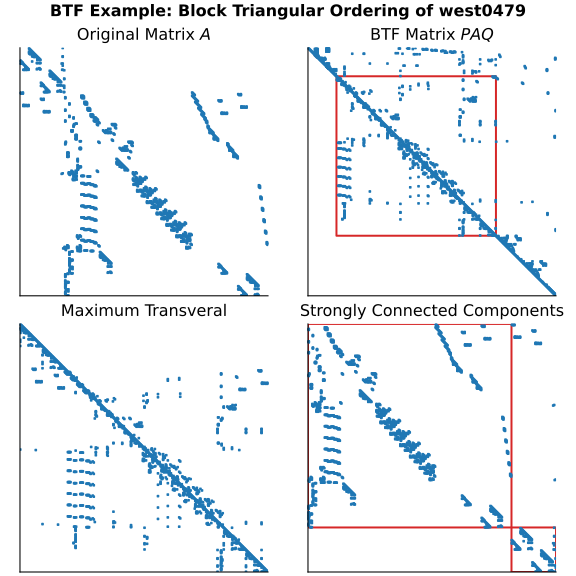
To see the effects of BTF ordering, we can load a sparse matrix from the SuiteSparse Matrix Collection and compute its ordering.
#!/usr/bin/env python3
# Part of the scikit-sparse project.
# Copyright (C) 2025 Bernard Roesler. All rights reserved.
# See pyproject.toml for full author list and LICENSE.txt for license details.
# SPDX-License-Identifier: BSD-2-Clause
#
# =============================================================================
#     File: btf_example.py
#  Created: 2025-08-07 14:03
# =============================================================================

"""An example of using the BTF (Block Triangular Form) algorithm."""

from pathlib import Path

import matplotlib.pyplot as plt
from scipy.io import mmread

from sksparse.btf import btf, btf_q_permutation, maxtrans, strongcomp


def plot_btf(A, p, q, r, ax=None):
    """Plot the blocks of the BTF matrix.

    Adapted from the SuiteSparse ``drawbtf.m`` [#drawbtf]_.

    Parameters
    ----------
    A : (N, N) sparse matrix
        A square, sparse matrix in CSC format.
    p, q : (N,) ndarray of int
        The row and column permutations that put ``A`` into upper block
        triangular form.
    r : (Nb + 1,) ndarray of int
        The indices of the block boundaries in the permuted matrix. The number
        of blocks is ``len(r) - 1``.
    ax : matplotlib.axes.Axes, optional
        The axes to plot on. If None, the current axes will be used.

    Returns
    -------
    ax : matplotlib.axes.Axes
        The axes with the BTF blocks plotted.

    References
    ----------
    .. [#drawbtf] MATLAB BTF plotting function:
        https://github.com/DrTimothyAldenDavis/SuiteSparse/blob/dev/BTF/MATLAB/drawbtf.m
    """
    if ax is None:
        ax = plt.gca()

    Nb = len(r) - 1
    q = btf_q_permutation(q)  # ensure q is a valid permutation

    for k in range(Nb):
        r0 = r[k]
        r1 = r[k + 1]
        Nk = r1 - r0
        if Nk > 1:
            # Plot the block
            ax.add_patch(
                plt.Rectangle(
                    (r0 - 0.5, r0 - 0.5),
                    Nk,
                    Nk,
                    fill=False,
                    edgecolor="C3",
                    linewidth=1.5,
                )
            )

    return ax


# Load the west0479 matrix (downloaded from the SuiteSparse Matrix Collection:
# <https://sparse.tamu.edu/HB/west0479>)
filepath = Path("data") / "west0479.mtx"
A = mmread(filepath, spmatrix=False).tocsc()  # read the matrix

# Compute the BTF ordering
p, q, r = btf(A)
q = btf_q_permutation(q)
PAQ = A[p][:, q]

# Compute the maximum transversal
qm = maxtrans(A)
A_mt = A[:, qm]

# Compute the strongly connected components
pcc, rcc = strongcomp(A)
A_scc = A[pcc][:, pcc]

# Plot the original and permuted matrices
plt.rcParams.update({"font.size": 10})

fig, axs = plt.subplots(num=1, nrows=2, ncols=2, clear=True)
fig.set_size_inches((6, 6), forward=True)
fig.set_constrained_layout(True)
fig.suptitle("BTF Example: Block Triangular Ordering of west0479")

ax = axs[0, 0]
ax.spy(A, markersize=1)
ax.set_title(r"Original Matrix $A$")

ax = axs[0, 1]
ax.spy(PAQ, markersize=1)
plot_btf(PAQ, p, q, r, ax=ax)
ax.set_title(r"BTF Matrix $PAQ$")

ax = axs[1, 0]
ax.spy(A_mt, markersize=1)
ax.set_title(r"Maximum Transveral")

ax = axs[1, 1]
ax.spy(A_scc, markersize=1)
plot_btf(A_scc, pcc, pcc, rcc, ax=ax)
ax.set_title(r"Strongly Connected Components")

for ax in axs.flat:
    ax.set_aspect("equal")
    ax.set_xticks([])
    ax.set_yticks([])

plt.show()
fig.savefig("btf_example.svg")
This figure shows the effect of BTF ordering:
Convenience Methods
The BTF package also provides a convenience function,
btf_q_permutation(), to get the actual q permutation vector.